Quick Win board and zones
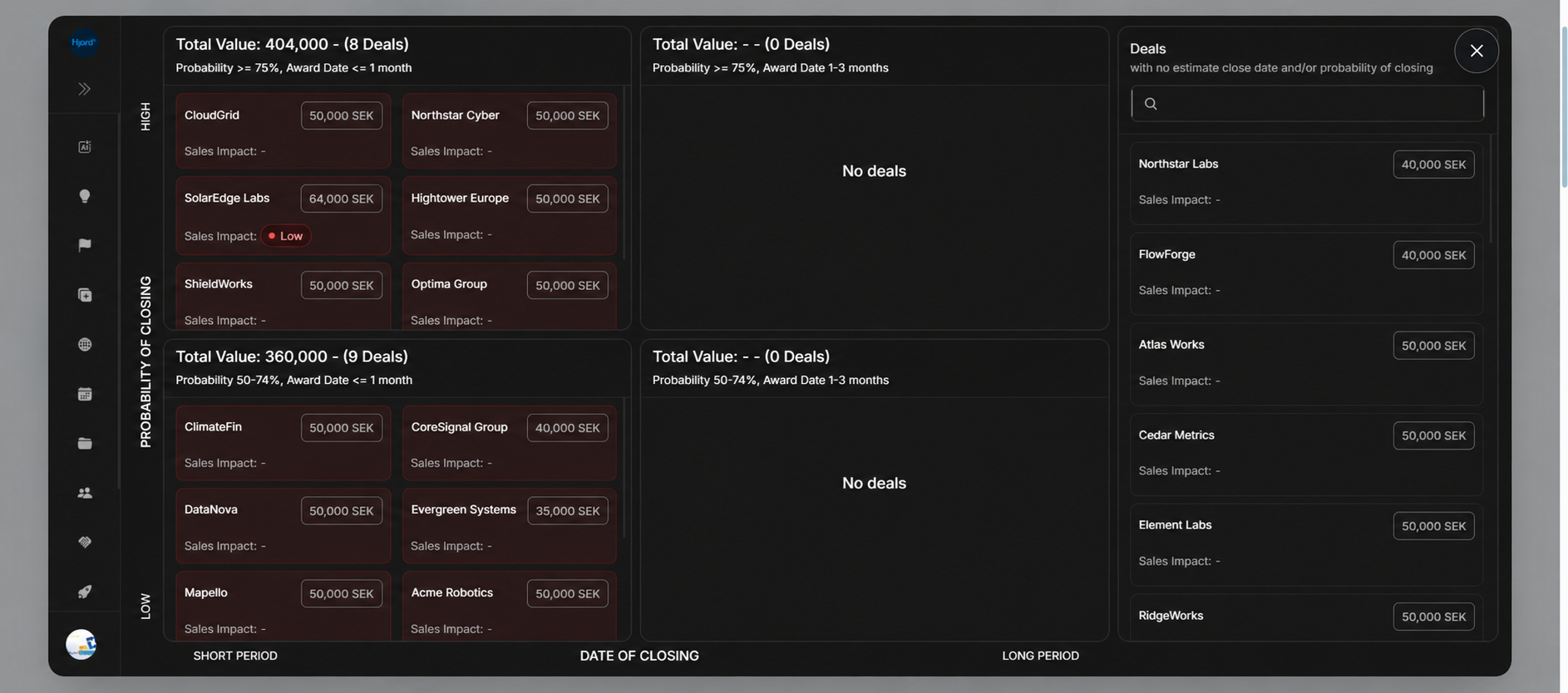
Quick Win board and zones
The Quick Win board is a two-axis deal prioritization view. It uses probability on the vertical axis and close timing on the horizontal axis.
Axes
| Axis | Values shown | What it means |
|---|---|---|
| Probability Of Closing | High, Low | How likely the deal is to close. |
| Date Of Closing | Short Period, Long Period | How soon the deal may close. |
The page uses Award Date in the zone subtitle and Date Of Closing on the
bottom axis. In the deal preview dialog, the same timing is represented by
Estimate Close Date.
Zone Rules Shown In The UI
| Zone label | Subtitle shown in the board | Meaning |
|---|---|---|
| High / Short Period | Probability >= 75%, Award Date <= 1 month | Best near-term opportunities to inspect first. |
| High / Long Period | Probability >= 75%, Award Date 1-3 or 1-6 months | Strong opportunities that need scheduled follow-up. |
| Low / Short Period | Probability 50-74%, Award Date <= 1 month | Near-term opportunities that need confidence or field work. |
| Low / Long Period | Probability 50-74%, Award Date 1-3 or 1-6 months | Longer-horizon opportunities to monitor. |
Each zone header shows total value and deal count for that zone. A -- total
means there are no deals in that zone.
Move A Deal Carefully
Moving a card is a forecast update, not only a visual rearrangement.
- Moving left or right changes Estimate Close Date to the destination period.
- Moving up or down changes Probability Of Closing to the destination band.
- Moving diagonally changes both fields.
- Moving a deal to the missing-data list clears its close date and probability.
On mobile, select the card and choose a destination from the drop area. After any move, open the preview and confirm the new values. The long period is 1–3 months in some workspaces and 1–6 months in others; follow the labels shown on your board.
Empty Zones
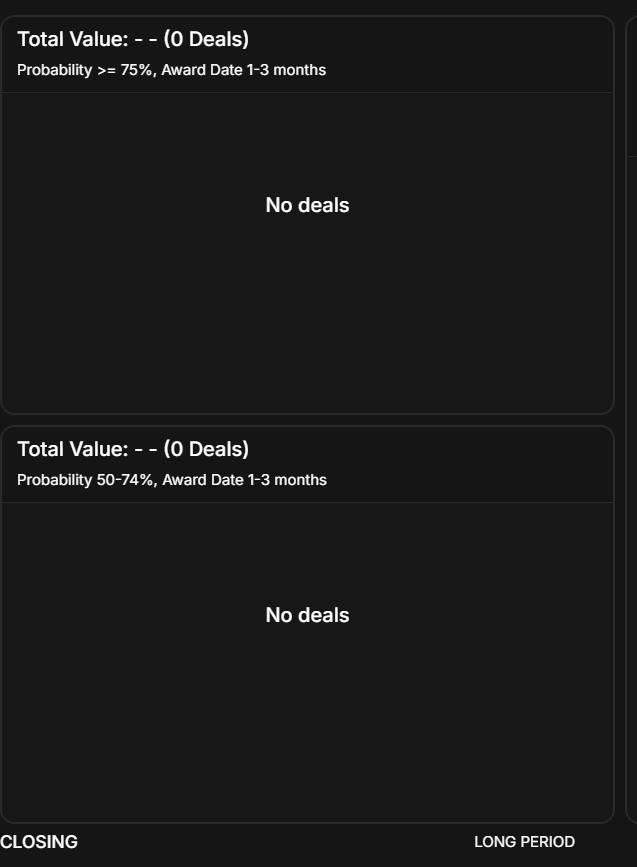
When a zone says No deals, no current deals match that probability and timing
combination. This is expected when the pipeline has no deals in that bucket or
when filters/data cleanup leave all matching deals elsewhere.
How To Prioritize The Board
- High / Short Period: inspect first because these deals are both likely and near-term.
- Low / Short Period: inspect next because the close date is near but confidence is lower.
- High / Long Period: schedule follow-up and keep stakeholder momentum.
- Low / Long Period: monitor, nurture, or clean data before prioritizing.