Define ideal stakeholder roles and risks
Define ideal stakeholder roles and risks
Use the Ideal Stakeholder Matrix to describe job positions, functions, seniority and optional decision roles for a buying situation. It defines whom Research should look for; it does not create people, assign Buying roles on saved profiles or add anyone into a Deal or Audience.
Open Context → GTM Foundation → Buying logics, then the relevant logic's stakeholder section.
Choose positions in the matrix
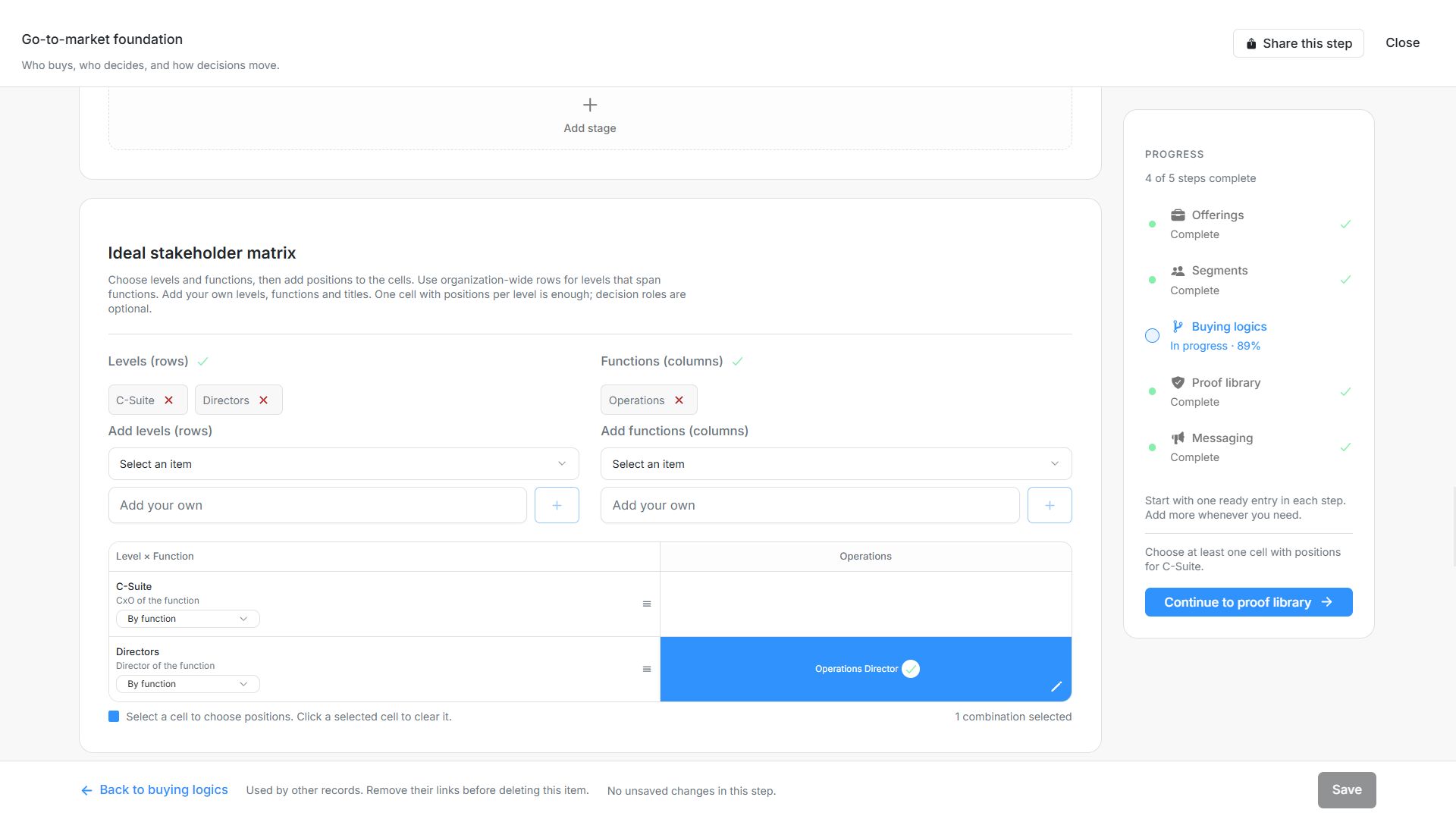
- Choose relevant Levels (rows) and Functions (columns). There are no default cell selections.
- Select a cell to open its position picker. Search suggested job titles or enter a custom position that fits this level and function.
- Add optional Decision roles, such as Champion or Sign-off, when useful. Position and decision role are separate: Chief Financial Officer is a job title, while Sign-off describes a responsibility.
- Add at least one relevant cell with positions for each chosen level when working toward completion. Do not fill every cell merely for progress.
- Save the Buying logic and inspect remaining-work guidance.
Clicking a selected cell to clear it removes both its positions and decision roles after the relevant confirmation. Save the step to retain that change. Use the cell's Edit positions action to adjust its selection without clearing everything.
Image guide: Seniority rows and function columns contain selected job positions. Fictional demonstration data in the current product, captured in light mode.
Use an organization-wide row
Board & Owners and CEO level start with an organization-wide layout when newly added. Any level can switch between functions and an organization-wide row. This is useful for people whose responsibility spans the company rather than one function.
Switching layout merges existing selections or moves them to the chosen function; it does not invent new job titles. Inspect retained positions and roles before saving.
| Field | What to describe |
|---|---|
| Levels / Functions | Seniority rows and the relevant business-function columns. |
| Positions | Searchable or custom job titles in the selected cell. |
| Decision roles | Optional commercial responsibilities for those positions. |
| What personal risk do they carry? | The downside these people bear if the decision goes wrong. |
| What proof would make the decision defensible? | Evidence they need to defend a choice; recording a need is not proof that evidence exists. |
| Which gate is blocked? | Recognition, Relevance or Safety, when known. |
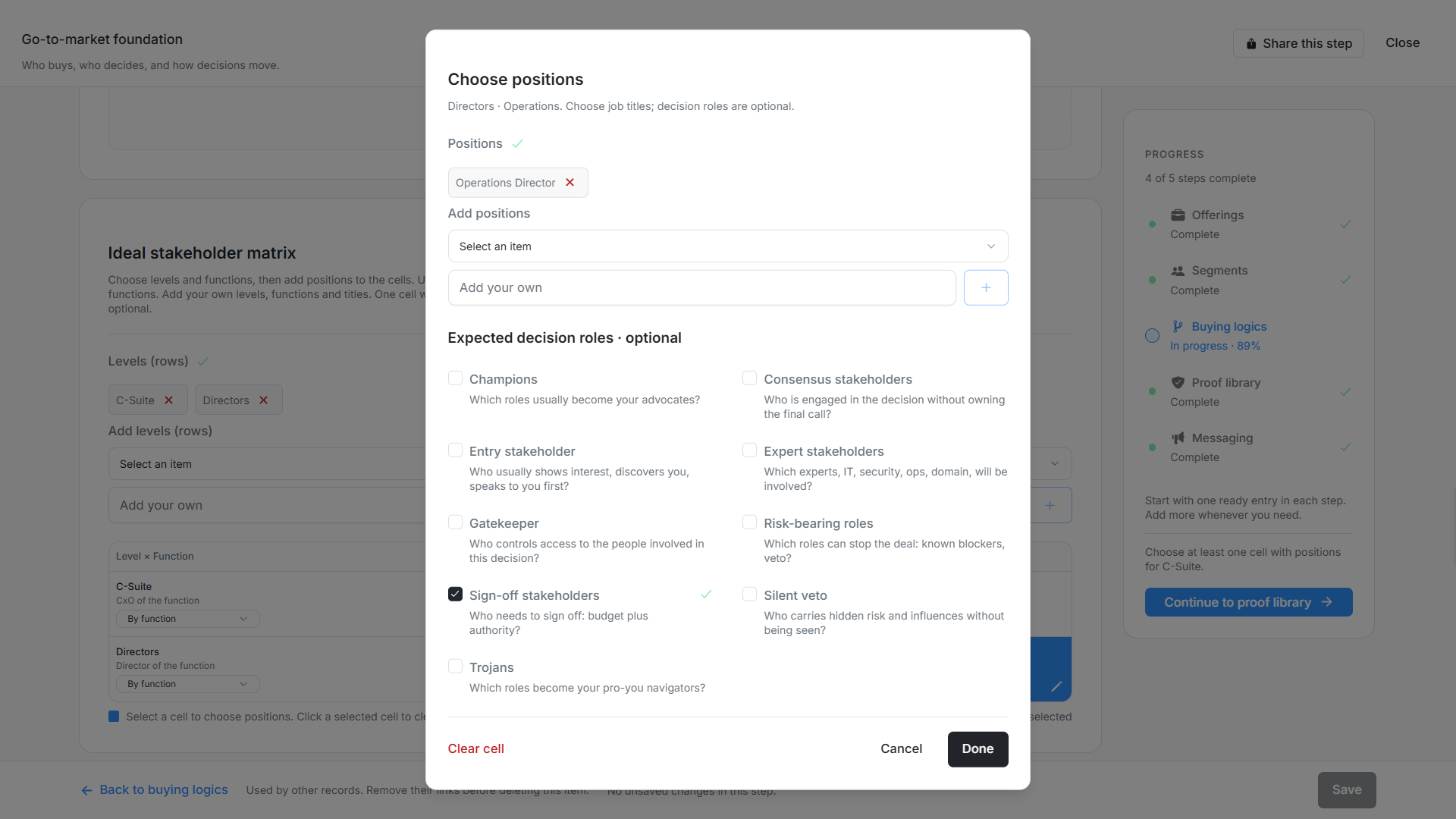
Image guide: The position picker supports suggested or custom titles and independent optional decision roles. Fictional demonstration data in the current product, captured in light mode.
Answer the stakeholder questions
Internal questions distinguish Entry, Consensus, Sign-off, Expert, Champion, Trojan Horse, Risk-bearing, Silent veto and Gatekeeper responsibilities where offered. Explain relevant roles rather than repeating a job title in every answer. Unselected internal roles and external questions remain optional.
External influences include consultants, regulators/politicians and partners/ecosystem. Record them only when they actually affect this buying situation. For a fictional production project, Operations may champion the change while Finance signs off; an external consultant belongs here only if involved.
Use the matrix in Research and actual records
Optional Buying Logics / ISMs guide stakeholder discovery through these positions, functions and seniority. A selected ISM without positions is rejected instead of silently broadening the search. Multiple selected ISMs share the per-account result allowance.
A saved stakeholder's Buying roles is a separate independent profile field. Research approval does not assign it. An actual Deal's named stakeholders and targeting map describe the current opportunity, not this ideal model.